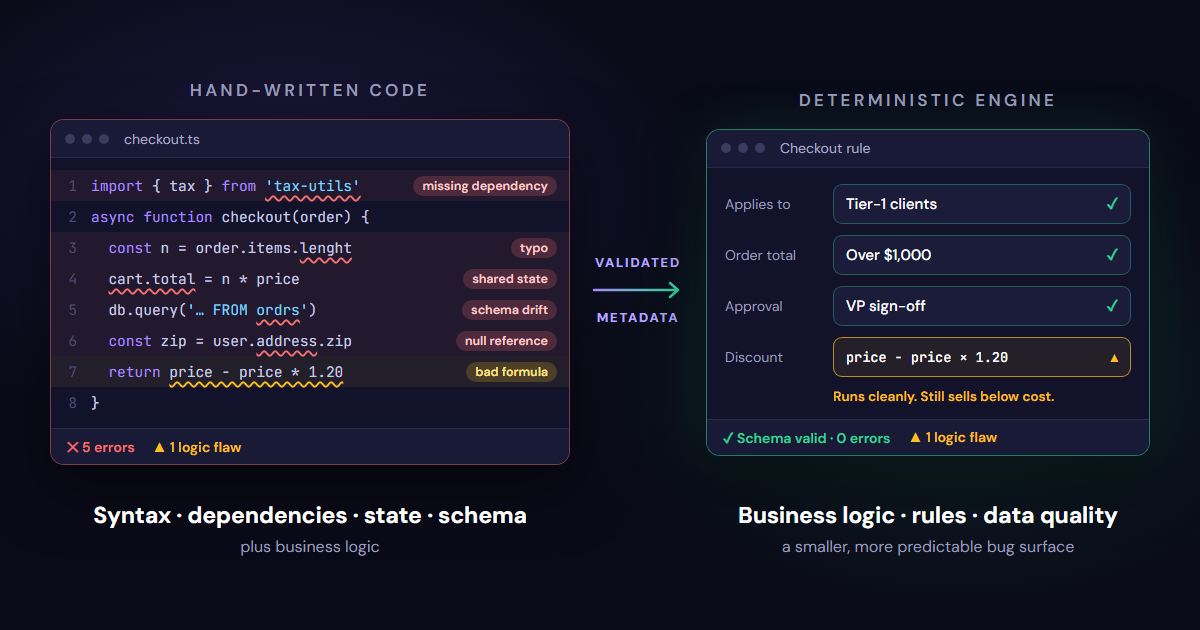
No-code does not eliminate software bugs. It can, however, constrain or remove an entire category of implementation-level defects—such as syntax errors, broken dependencies, type mismatches, and unindexed database queries—by replacing hand-written application code with validated, schema-enforced configuration. The remaining operational risk moves toward business logic, requirements accuracy, rule priority, and data quality.
In traditional software development, engineers write and maintain an imperative implementation layer that translates business requirements into executable source code. That translation layer introduces a continuous stream of technical defects: null pointer crashes, state mutation race conditions, dependency rots, and schema drift.
A deterministic, metadata-driven architecture alters this model. Instead of compiling custom code paths for every workflow, application structure and behavior are defined as validated metadata records executed by a controlled platform runtime. The result is not an infallible application—it is a fundamentally smaller, more predictable bug surface.
No-Code Doesn't Mean Bug-Free
In the enterprise software space, "zero code means zero bugs" is a persistent marketing myth. Technical buyers, CTOs, and systems architects know this claim is false. Any system running complex business processes can fail.
The meaningful architectural question is not whether a no-code platform can have bugs. It can. The question is where those bugs originate when application behavior is governed by structured metadata rather than custom source code.
When a traditional codebase breaks, the failure often stems from execution plumbing: a misplaced bracket, an unhandled async edge case, or an incompatible library patch. When a metadata-driven system breaks, the failure almost always stems from human intent: an incorrect formula, an unhandled business condition, or flawed data assumptions.
The Problem Isn't Always the Code—It's the Translation Layer
In custom software engineering, defects rarely happen because an architect misunderstood a clear business goal. They happen in the translation layer—the gap between what a human intended to build and how a computer executes syntax, allocates memory, and references dependencies.
When developers write imperative code in Python, TypeScript, or Java, they explicitly instruct the computer how to handle state transitions, query databases, and parse payloads. A single typo or unexpected null API response can crash a thread.
Metadata-driven platforms eliminate this hand-written translation step. Developers declare what the system should accomplish through visual, schema-validated rules. The platform runtime executes those rules deterministically, removing user-written syntax from the runtime path.
What Is Deterministic Architecture?
Deterministic architecture is a system design pattern where application structure, data relationships, and workflows are stored as structured metadata and executed by a pre-tested platform engine.
Given identical metadata configurations and identical input data, a deterministic engine will execute the exact same sequence of state transitions every single time.
Key characteristics of this architecture include:
- Design-Time Validation: Configurations are checked against strict relational schemas before changes are committed or saved.
- Separation of Engine and Configuration: The application codebase is frozen within the platform engine; users only modify configuration parameters.
- Contract-Driven Connections: Application modules communicate through typed contracts rather than fragile code imports.
Imperative Code vs. Declarative Metadata
The shift from imperative programming (step-by-step code instructions) to declarative metadata (defining target states) alters how technical errors are handled at runtime.
| Technical Risk Area | Traditional Imperative Code | Metadata-Driven Architecture | Impact on Defect Surface |
|---|---|---|---|
| Syntax & Typo Errors | Misspelled variables, missing brackets, or unclosed calls crash runtime threads. | Configurations are validated against JSON/relational schemas at design time. | Prevented by construction: Invalid syntax cannot be saved or deployed. |
| State Mutation & Side Effects | Function A silently mutates in-memory state relied on by Function B, causing race conditions. | State transitions are managed deterministically by platform rules. | Constrained: Reduces thread locks, memory leaks, and erratic state drift. |
| Dependency Management | Updating external packages breaks backward compatibility across multiple files. | Components connect through typed, platform-enforced contract interfaces. | Removed from app layer: Platform ensures referential integrity prior to committing. |
| Database Schema Drift | Hand-written ORM migrations fail or target renamed columns, breaking queries. | The platform engine updates schemas, foreign keys, and indexes directly from the metadata model. | Managed by platform: Reduces orphan records, unindexed queries, and SQL injection exposure. |
Which Software Bugs Can Deterministic Architecture Prevent?
Deterministic architecture constrains low-level implementation bugs by verifying application structures before they reach a production environment.
1. Syntax and Structural Defects
In conventional source code, an unclosed brace or misspelled property name causes compile failures or runtime crashes. In a metadata-driven environment, input forms and visual builders enforce structural rules. Unresolved variables or invalid nodes are flagged before the configuration is saved.
2. Invalid References and Dependency Rot
Upgrading third-party libraries in traditional applications frequently introduces breaking changes across node_modules or library imports. On a deterministic metadata platform, individual visual blocks interact through typed contracts. If a developer attempts to delete a data field referenced by an active workflow, the platform validator rejects the deletion until the dependency is resolved.
3. Database Schema Mismatches
Mismatches between application code and database schemas are a frequent cause of enterprise downtime. Metadata platforms orchestrate schema changes directly from the application's visual data model. Foreign keys, index generation, and column renames are applied synchronously, mitigating orphan records and unindexed queries.
4. Unintended State Mutations
When parallel processes mutate a shared in-memory object, diagnosing the resulting race conditions can take days. Deterministic engines enforce explicit state machines, ensuring state updates occur sequentially and predictably.
Which Bugs Does Deterministic Architecture NOT Prevent?
A deterministic runtime engine executes instructions precisely as configured. If an operator sets up an illogical business rule, the engine will execute that rule without throwing an exception.
The risk profile shifts from implementation mechanics to three domain-level failure modes:
1. Flawed Mathematical or Domain Logic
If a user configures a promotional discount formula as:
Final Price = Unit Cost − (Unit Cost × 1.20)
The engine runs that calculation cleanly. It will not crash, throw an unhandled exception, or output a stack trace. It will process transactions efficiently while selling inventory at a negative profit margin. The engine worked as designed; the human logic was flawed.
2. Conflicting Business Rules
Consider an application configured with two active policies:
- Rule A: "All purchase orders over $1,000 require VP sign-off."
- Rule B: "All Tier-1 enterprise clients bypass manual sign-off workflows."
When a Tier-1 client places a $5,000 order, which rule takes priority? If the system architect did not define rule precedence, the outcome will surprise the business—even though the platform executed predictably.
3. Bad Assumptions About External Data
If an ingestion pipeline expects an external SQL database to provide a DateOfBirth timestamp, but half the legacy rows contain string values like "N/A", the engine's ingestion logic may route those records to an exception queue. The application did not crash, but the business process stalled due to unvalidated data assumptions.
What Changes for Enterprise Software Teams?
Enterprise software teams spend a significant portion of their capacity maintaining existing code. Classical research in software engineering economics—such as studies by Barry Boehm—and ongoing industry analyses indicate that software maintenance and evolution historically consume 50% to 80% of total lifecycle costs.
Much of that maintenance overhead goes toward mechanical tasks: updating language dependencies, fixing null pointers, patching broken API glue, and repairing ORM migration scripts.
Shifting the implementation layer to a deterministic runtime changes daily team operations:
- Engineering Bandwidth Shifts: Senior architects spend less time fixing syntax errors, dependency rot, and deployment scripts, allocating more time to data relationships and workflow modeling.
- QA Focus Transforms: Quality assurance shifts from testing basic runtime stability (e.g., verifying that an endpoint doesn't return
500 Server Error) to scenario testing (e.g., verifying edge-case business logic). - Incident Resolution Accelerates: When a production issue occurs, engineers do not need to sift through thousands of lines of custom code or stack traces. They look directly at the metadata configuration to identify rule oversights.
Why We Chose This Architecture for DeciCore
When we began building Deciphai, we observed a repeating pattern across enterprise software development: generating code faster does not make software easier to maintain.
Many low-code tools focus on generating standard source code under the hood. While this speeds up the initial release, it creates a maintenance challenge over time. A company with 50 generated applications eventually finds itself managing 50 custom codebases, complete with dependency updates, security patches, and language upgrades.
That realization led us to take a different approach with DeciCore: What if an application didn't need custom source code to execute custom workflows?
By building DeciCore on a deterministic, metadata-driven architecture, we separated execution mechanics from application definitions. The engine handles security, state, database interactions, and integrations. The user configures metadata records that describe how their business works.
This model does not eliminate human error, but it ensures that technical teams spend their energy refining business logic rather than maintaining software plumbing.
The Real Benefit: A Smaller, More Predictable Bug Surface
The goal of deterministic metadata architecture is not to promise bug-free software. That claim is unrealistic.
The true benefit is establishing a smaller, more transparent failure surface. By replacing hand-written imperative code with schema-validated metadata, platforms like DeciCore constrain technical implementation errors by construction.
You don't eliminate operational risk. You convert complex, hard-to-trace code bugs into clear business-logic configurations that are faster to isolate, easier to understand, and cheaper to fix.
Frequently Asked Questions
Can no-code applications still have software bugs?
Yes. While metadata-driven systems constrain syntax, memory, and structural code errors, applications remain vulnerable to business-logic flaws, incorrect mathematical formulas, conflicting operational rules, and poor external data quality.
What is the difference between imperative and declarative programming in this context?
Imperative programming requires developers to write explicit, step-by-step code instructing the computer how to execute a task, which introduces potential syntax, memory, and state errors. Declarative metadata defines what the system should achieve, leaving the execution mechanics to a pre-tested platform engine.
How does deterministic architecture manage database schema changes?
In a metadata-driven platform, database schemas are generated directly from the visual application model. When an administrator renames a field or updates a relationship, the engine manages indexes, foreign keys, and migrations automatically, reducing schema drift.
Does a metadata-driven architecture limit application customizability?
It restricts low-level code customizations, such as writing custom memory handlers or language-specific hacks. However, for enterprise applications, it provides extensive flexibility through configurable workflows, rule engines, API integrations, and data models.
How does deterministic execution change quality assurance (QA) processes?
Because the platform engine ensures runtime and memory stability, QA teams do not need to spend time testing basic code compilation or server setup. QA efforts focus on validating business edge cases, rule priorities, and user interface workflows.