You can build internal software without hiring developers by having the people who own a process describe it in plain language to a governed, AI-native platform that generates the application for them. That removes the engineering backlog from the path without removing IT's visibility, permissions, or control. It is how operations and business teams are getting real systems for the processes IT will never have bandwidth for, without going around IT and without waiting for it.
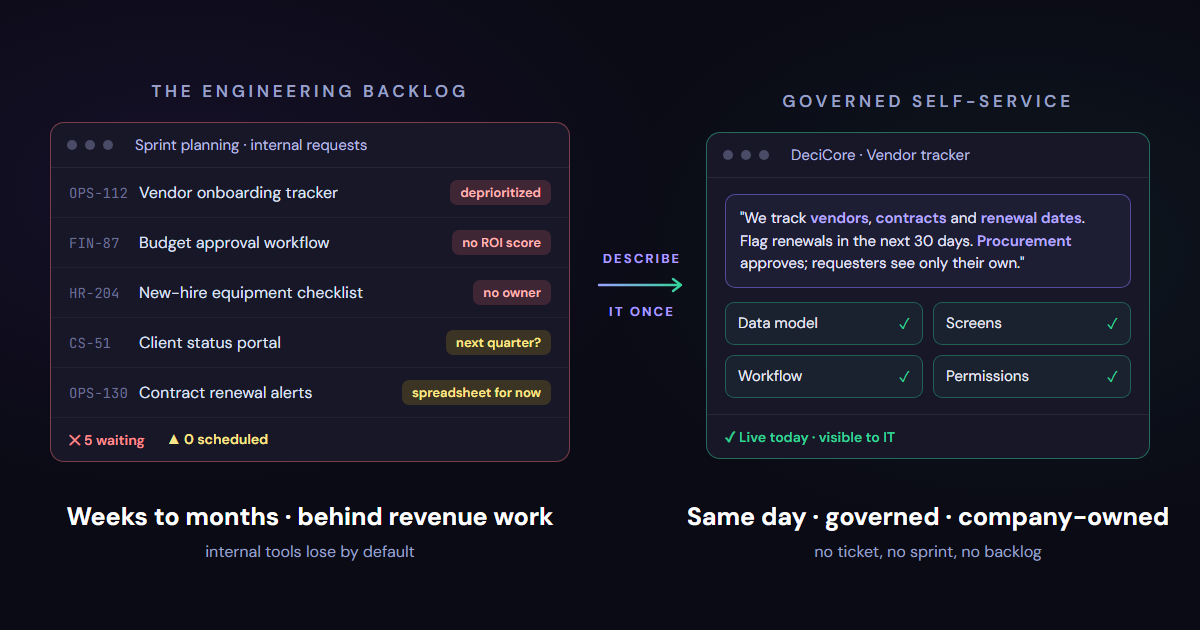
Every company has the same quiet backlog problem. Internal tools sit behind customer-facing features in every sprint planning meeting, indefinitely: the approval workflow, the vendor tracker, the onboarding checklist, the client portal nobody outside the account team ever sees. That isn't because engineering doesn't care. The math is brutal: a developer's time spent on an internal budgeting tool is time not spent on the product that generates revenue. That tradeoff is rational for the business and miserable for the team stuck running the process by hand.
So the real question underneath "how do I build internal software without hiring developers" is this: how do you get a real, reliable system for a process IT will never have bandwidth for, without creating a security or governance mess?
Why Internal Software Requests Never Move Up the Backlog
It's worth naming why this happens, because the fix depends on understanding it:
- Internal tools have no revenue attribution. A feature that helps a customer buy something has a clear ROI story. A tool that saves the finance team four hours a week doesn't compete on the same scoring model.
- They're "simple," which makes them lower priority, not easier. Everyone agrees the vendor-onboarding tracker is a small project. Small projects are exactly what gets deprioritized indefinitely, because nothing forces the deadline.
- Requirements come from a different department than the builders. Operations knows the process; engineering knows the stack. Every internal tool request pays a translation tax before a single line of code gets written.
- There's no dedicated owner. Customer-facing roadmaps have product managers fighting for prioritization. Internal tools usually don't, so they lose by default, not by decision.
None of this means the request was wrong. It means the traditional path (file a ticket, wait for a sprint, get a developer assigned) was never going to work for this category of problem.
Can Business Teams Really Build Their Own Software?
Yes. Citizen development is the practice of non-engineers building real operational software, using tools designed for people who understand the process rather than the codebase.
The important distinction is between citizen development done with guardrails and the thing IT actually fears: shadow IT. Shadow IT means ungoverned tools, unmanaged spreadsheets, personal Airtable bases with customer data in them, and nobody tracking who has access to what. Shadow IT isn't a citizen-development problem; it's a governance problem. The goal isn't to stop business teams from building software. It's to give them a way to do it that IT can see, govern, and trust.
That's the gap a genuinely useful "no developers required" platform has to close: fast enough that operations teams don't route around it, and governed enough that IT doesn't have to clean up after it.
How Do I Build Internal Tools Without IT?
"Without IT" shouldn't mean without IT's visibility. It should mean without IT's time. The three realistic options compare like this:
| Criteria | Shadow IT (spreadsheets, personal tools) | Traditional dev request | AI-native builder with governance (DeciCore) |
|---|---|---|---|
| Speed | Immediate | Weeks to months | Same day |
| Who builds it | Whoever is frustrated enough | Engineering, when scheduled | The person who owns the process |
| IT visibility | None | Full | Full, centrally governed |
| Security and permissions | None | Enforced by engineering | Built in by default |
| Data ownership | Unclear, scattered | Company-owned | Company-owned, no lock-in |
| Scales past one team? | No | Yes, slowly | Yes, immediately |
This is precisely what DeciCore is built around. A platform admin console gives IT a central place to govern every tenant, every plan, and every application built on top of it: global telemetry, usage analytics, governance rules, billing policies, and structural feature flags, all visible from one place. Meanwhile, the actual builders are the operations people who understand the process. IT gets the oversight it needs without being the bottleneck; the business gets the speed it needs without going rogue.
How Operations Teams Can Build Their Own Software
The mechanics are simpler than most people expect. Building software with an AI-native platform is really just formalizing a description you could already give a new hire:
- Describe the entities. "We track vendors, contracts, and renewal dates."
- Describe the rules. "Flag any contract renewing in the next 30 days and notify procurement."
- Describe who does what. "Procurement can approve; requesters can only submit and view their own requests."
- Describe what it should look like day to day. A dashboard, a form, a list view, described in plain language rather than designed in a tool you have to learn first.
With DeciCore, that description is the build process. The platform's AI engine, DeciBrain, takes it and generates the actual data model, the UI screens, and the backend workflow logic. That's the same thing a developer would eventually hand back after a requirements meeting, a data model, and a sprint, except it's produced directly from the description of the problem.
How Do I Create Custom Internal Tools Without Coding?
In practice, most "we need software for this" requests inside a company fall into a short list of patterns:
- Approval workflows: budget requests, PTO, purchase orders, contract sign-off.
- Trackers with a status lifecycle: vendor onboarding, hiring pipelines, asset and equipment tracking, incident logs.
- Internal directories with relationships: client rosters linked to deals, employees linked to equipment, projects linked to tasks and owners.
- Lightweight portals: a place for an external partner or client to submit something or check a status, without full system access.
Every one of these is a data model plus a workflow plus a permission structure, which are exactly the three things a no-code AI builder generates from a plain-language description. None of them require custom algorithms, unique infrastructure, or specialized engineering. That's exactly why they're the ones stuck at the bottom of every backlog: too "simple" to prioritize, too real to keep running in email threads and spreadsheets.
How Do Companies Build Internal Software at Scale?
Once one team proves this works, the pattern that follows isn't "everyone builds anything, unsupervised." It's structured self-service. Mature organizations set this up deliberately:
- A central admin layer where IT or a platform team can see everything being built, who built it, and who has access. DeciCore's master console is built for exactly this, with multi-tenant governance from day one rather than bolted on later.
- Pre-built architectural templates that IT can seed for common request types (an approval workflow, an intake form, a tracker), so business teams start from a governed pattern instead of a blank page.
- Clear ownership of the output. Whatever gets built belongs to the company. It isn't locked into a vendor's proprietary format or dependent on one person's account, so it survives team changes and doesn't become the next piece of shadow IT by another name.
This is the actual end state of "build internal software without hiring developers" at a company level: not one team quietly working around IT, but a governed self-service layer where the backlog stops being the constraint.
What Do I Do When IT Doesn't Have Time for My Process?
If a process is well-defined enough to explain clearly (who's involved, what data it touches, what triggers what), it doesn't need to wait for an engineering sprint. It needs someone to describe it to a system that can build it directly.
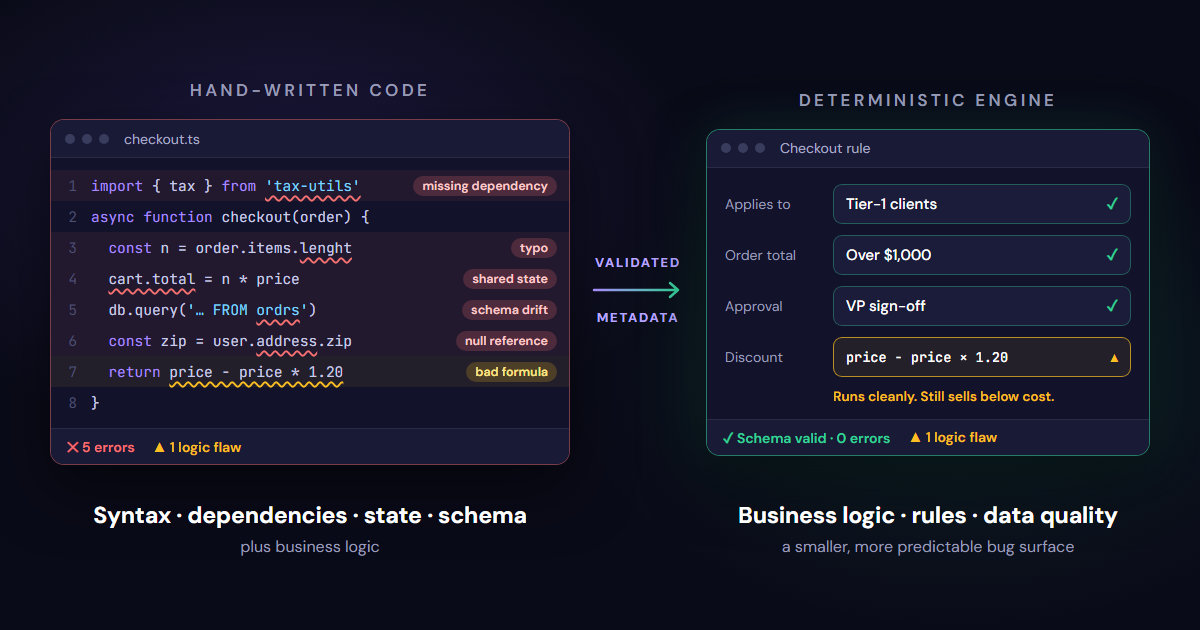
That's the practical unlock. The bottleneck was never really "we need code." It was "we need someone with development time." An AI-native platform removes that dependency without removing the governance IT still rightly wants. For a deeper look at why that matters for reliability, see how deterministic architecture improves software reliability.
Frequently Asked Questions
How do I build internal software without developers?
Use an AI-native, prompt-to-app platform that generates the data model, UI, and workflow logic directly from a plain-language description of the process. No coding, no builder tutorial, and no development team required.
How do I build internal tools without IT?
"Without IT" should mean without consuming IT's time, not without IT's visibility. Platforms with centralized governance, like DeciCore's admin console, let business teams build directly while IT retains oversight, permissions control, and usage visibility.
How can operations teams build their own software?
By describing the process the way they'd explain it to a new hire (the entities involved, the rules that govern it, and who's allowed to do what) and letting an AI-native platform generate the actual application from that description.
Can business teams build internal applications?
Yes. This is an established practice called citizen development. Done with proper governance, it's distinct from shadow IT: the difference is centralized visibility, access control, and company ownership of what gets built.
How do I create custom internal tools without coding?
Identify the pattern your need falls into (an approval workflow, a status tracker, a linked directory, or a lightweight portal), then describe it in plain language to an AI-native builder, which generates the data model, screens, and logic automatically.
How do companies build internal software?
Increasingly, through governed self-service: a central platform where IT sets guardrails and templates, and business teams build the specific tools they need directly, without filing a ticket and waiting for a sprint.
How do I build software for a process IT doesn't have time for?
If you can clearly describe the process (the data, the rules, and the people involved) you can hand that description directly to an AI-native platform like DeciCore and get a working, company-owned application the same day, without adding to the engineering backlog.